
Christmas Countdown 20 : Christmas Tree #6 - Play Bricks


Lego Creator Kit -
  1. https://www.ebay.com.au/itm/173410045102
Advent Blog Day 6 - Play Bricks (LEGO) 
Most of us know many small people who will receive LEGO as a Christmas gift. I am sure I don't really need to explain what LEGO are as there would be few in the world who do not know the  Danish toy company LEGO - the name now synonymous worldwide with the toy system of plastic interlocking bricks. I shouldn't be surprised that Christmas trees made of LEGO  have been found in many different countries.

A massive 10 metres tall built in  Pitt Street Mall, Sydney ( NSW Australia) made from 500,000 LEGO  and DUPLO (larger LEGO) pieces. Not to be outdone, a similar tree was built in Auckland, New Zealand- a similar size and design  and with the same number of LEGO and DUPLO bricks. What really appealed to me with the New Zealand tree were  not only the southern hemisphere Santa Claus but also the  LEGO models of a couple of Kiwis and a Pukeko sporting a festive hat. 


Auckland LEGO Tree:  https://brickset.com/article/25275/auckland-s-huge-lego-christmas-tree

And here is a one minute video time lapse of how this huge Christmas tree was built 

A much larger LEGO tree dominated London's St Pancras Station a few years ago in 2011. It was made with 600,000 LEGO pieces, with 'baubles" created by hundreds of school children. 
St Pancras LEGO tree:http://www.rail.co.uk/rail-news/2011/600000-piece-lego-christmas-tree/

https://www.theverge.com/2011/11/26/2587618/lego-christmas-tree-london-st-pancras
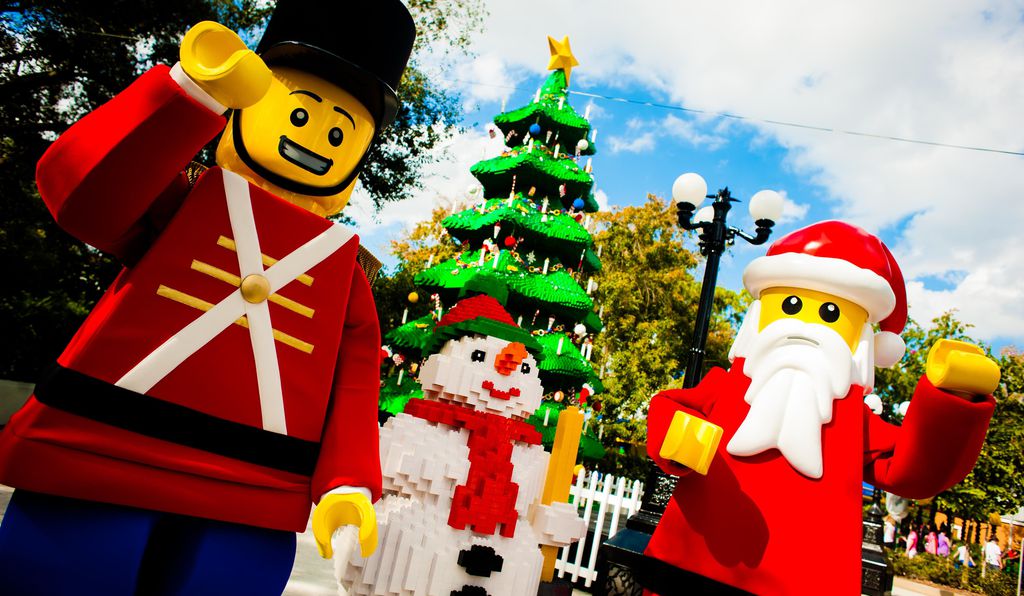
In Florida, USA,  one of the attractions at this time of the year is Bricktacular., with its giant LEGO Christmas tree made more magical with colourful lighting. 
https://www.smithsonianmag.com/travel/christmas-trees-reinvented-180961280/


As spectacular as these LEGO trees are, the simple do- it -yourself LEGO Christmas scenes with tiny LEGO trees  have a certain charm . 
  1. https://www.pinterest.com.au/pin/401594491746964054/
https://www.pinterest.com.au/pin/543246773771333084/
Who's getting LEGO for Christmas? 
I hope you'll be back tomorrow for another crazy idea for a Christmas tree.  

Comments

Popular posts from this blog

Wednesday's Child /2

Work in Progress - 3 of the 193 for "Stitched Up"- Wilma Simmons   The work for the "Stitched Up " Project  continues. See the previous "Wednesday Child" post for the background to this art project celebrating the 150th anniversary of the Newcastle Industrial School. I have been documenting the progress of my work, so I thought it might be interesting to share some of the early stages of the "stick dolls" ... Here are some of the beginning steps.. Sticks collected while walking the bushland in my neighbourhood  Drying and getting rid of any insects - oven heat 75 degreesC for approx 1-2 hours.  Trimmed and cut if necessary  Ends sealed with matte sealing solution.  Drying  - solution goes on white but dries clear.  First wrapping - foil to create a body shape  Second wrapping - stretch fabric.  Third wrapping - fabric strips  Some stitching - more stitching and embellishment to ...

Evolution of Message Stick Art Dolls

Message Stick Art Doll - stick, polymer clay, hand dyed & stencilled fabric with embroidery  My    message stick art dolls    have evolved over the last couple of years.  Why have I called these art dolls “Message Sticks” ?    I wanted to recreate a doll which was based on traditional techniques, so I have used ideas from a few different cultures. Many traditional dolls were made from wood - often wrapped with fibres.   In Egypt, several types of paddle dolls have been discovered in tombs in Egypt. The dolls are made of wood, flat, and constructed in a shape has led the form to be called a 'paddle doll'. The dolls seemingly follow a convention for the female figure, emphasizing the hips and hair. The wooden figures are usually painted with a geometric pattern of lines and dots. These patterns may reproduce tattos or ritual scaring in female Egyptian culture of the period or represent clothing or jewellery.  A fine exampl...

"Temari Or Not Temari?" Tutorial

 Background Information:  Temari (literally translated “hand ball”) is a Japanese folk craft that is alleged to have originated in China and was introduced to Japan five or six hundred years ago. Traditionally, the balls were constructed from wrapped kimono fabric remnants and silk threads. They were made by mothers and grandmothers for children to play with. Nowadays, decorative embroidered temari represent a highly valued and cherished gift symbolizing friendship and loyalty. Recently I've wondered if your don't use traditional techniques whether you should call what you create "temari". That is an ongoing debate but today I share what I do to make a "non-traditional temari".... 1.I start  with a polystrene ball ( traditionally the balls were wound  silk scraps or other organic materials) and begin to wrap with approx 4 ply wool, turning the ball as I wrap.  2. I then wrap another layer of wool in a similar fashion , this time a 3 or 2 ...