Exhibitions


                                                              "Leaves of Distinction " 
Textile/Mixed Media art using tea bags and tea dyed fabrics. 
18 September - 12 October 2014 
Timeless Textiles Gallery, 90 Hunter Street, Newcastle East 
for more information about this art work contact Timeless Textiles - anne@timelesstextiles.com.au

Here is a video explanation of some of the techniques 
Lu Tong's Seven Cups of  Tea 
The Tea Masters of Assam - The Connoisseur, the Merchant, the Purveyor 
Bohea - a variation of Lapsang Souchong Tea 
There once was a man from Vienna, Who lived on a tincture of Senna,
When that did not agree, he drank camomile tea, That nasty old man from Vienna. 
There once was a man on the Border, Who lived in the utmost disorder,
He danced with his cat and drank tea from his hat, Which vexed all the folk on the Border. 
There once was a man from Dumbree, Who taught little owls to drink tea,
For he said"to eat mice. is not proper or nice, That amiable man from Dumbree" 
Rose Keemun - black tea with rose petals 
Masala Chai - black tea flavoured with Indian spices 
Lady Grey - variation of Earl Grey tea 
Falling leaves - leaves captured between waxed tea leaves
Flowers 1, 2 & 3 


Red Zinger Sky 1, 2 & 3 


Tea Travels 1,2 & 3 

August Moon 1 - West Lake Pagoda , Hangzhou 

August Moon 2 - Wild Goose Pagoda , Xian 

August Moon 3 - Central Hall Birmingham UK 

August Moon 4 - St Stephan's Passau Germany 

Between dinner and tea - Sophia Rose Redrup 

Votes for Women - Mary Jane Russell 

Sitting in the shade drinking tea - Su See 
Solitary tea - Jan See 


Tea Travels 4,5 & 6 - Mando PNG 

Book of Seasons 

Book of Leaves and Opal 

Tea Tags
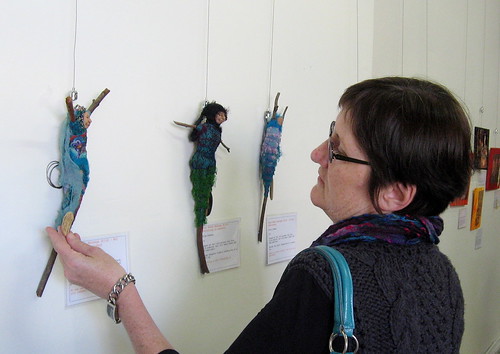
Tea Thoughts - Message Stick Dolls selection


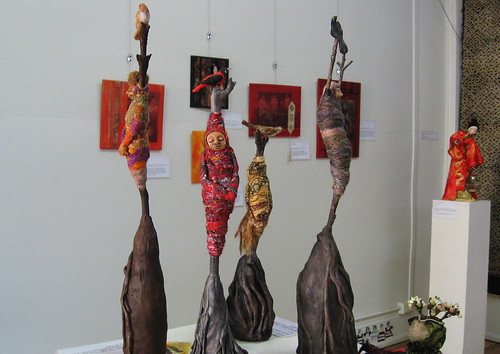
Wise Women Exhibition 2012 at Timeless Textiles gallery 

Chatting about the exhibits on video

Comments

Popular posts from this blog

Fish and Sticks : Art Dolls

This week I've been working on fish and sticks ....  The sticks are the message stick art dolls which were very popular, attracting some attention and a few orders at the Wise Women exhibition. Each of the message stick dolls are from the Wise Women series, each with her own personality and  message of wisdom, handwritten on a handmade timber tag. I gather the sticks during my walks around my neighbourhood and the tags are made from special bits of timber, some collected by me or  my husband or from off cuts gifted to us  from another doll making friend whose husband makes bagpipes. These dolls start off very simply with a wrap around a stick, in the general shape of a body. 'Naked" message stick dolls - strips of wadding wrapped around found sticks.   Then I usually wrap other layers of fabric, wool, and/or fibres, over which I do some simple embroidery. I sculpt  or mould small face masks for these dolls. I really like using "sari ribbon" as w...

Lilly Pilly

Today is Australia Day. I chose a photo of some Lilly Pilly berries as a celebratory image for this national day. Lilly Pilly is  a common name for a plant, Syzygium smithii which grows mostly in Eastern Australia, from the northern  rain forests of Queensland, throughout NSW to the southern Wilson's Promontory in Victoria. In New Zealand it is called "monkey apple, but other names used in Australia, besides lilly pilly, are Eungella Gum and Coast Satinash. The largest Lilly Pilly recorded was found in Dingo Creek Flora Reserve, near Tenterfield where I once lived.  The tree now growing in my garden was once a small seedling which I was gifted when I left Woolgoolga, a small coastal town in northern NSW. Its name  is said to come from the Aboriginal word 'weelgoolga' describing the lilly pilly which grows in profusion there. It is probably no surprise that the lilly pilly berries are edible as bush tucker, and make a beautiful jam or jelly. I have even seen re...

"Temari Or Not Temari?" Tutorial

 Background Information:  Temari (literally translated “hand ball”) is a Japanese folk craft that is alleged to have originated in China and was introduced to Japan five or six hundred years ago. Traditionally, the balls were constructed from wrapped kimono fabric remnants and silk threads. They were made by mothers and grandmothers for children to play with. Nowadays, decorative embroidered temari represent a highly valued and cherished gift symbolizing friendship and loyalty. Recently I've wondered if your don't use traditional techniques whether you should call what you create "temari". That is an ongoing debate but today I share what I do to make a "non-traditional temari".... 1.I start  with a polystrene ball ( traditionally the balls were wound  silk scraps or other organic materials) and begin to wrap with approx 4 ply wool, turning the ball as I wrap.  2. I then wrap another layer of wool in a similar fashion , this time a 3 or 2 ...