The 100 Day Project #3 & #4


Days 3 and 4 #The100DayProject #100pinpoems

My pin poem for day 2 was rather dark and I heard that my granddaughter was finding self isolation and schooling from home was a bit difficult last week. #3 then became an affirmation, far from a traditional haiku but still with the  3 line formation with 5-7-5 syllables. 
Be like a princess
Wear your invisible crown 
Love the self you are. 
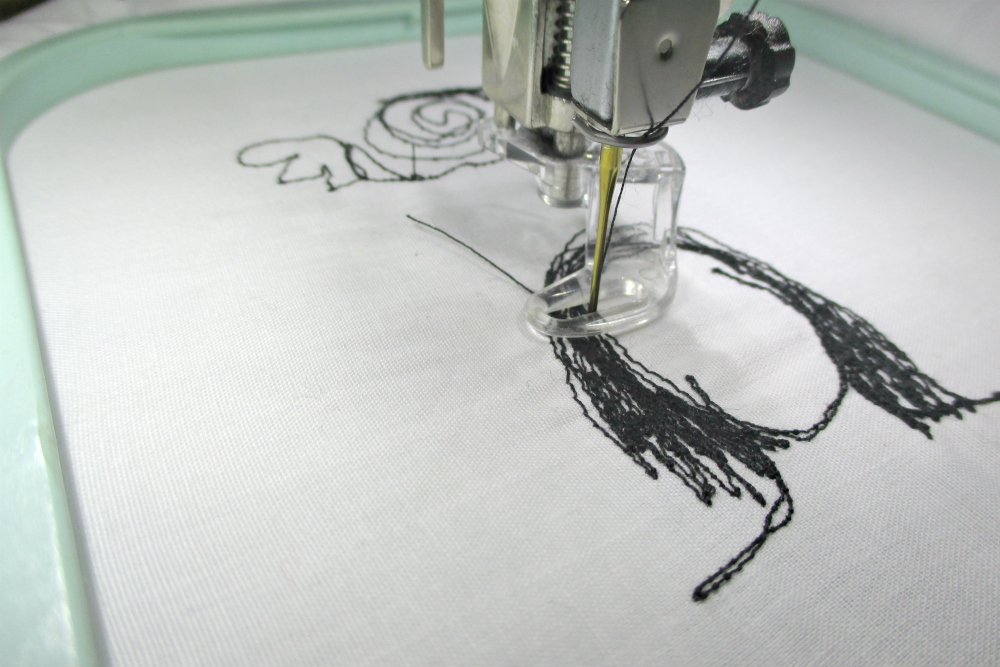
The pin is a machine embroidered one - free form. This is done fairly quickly, directly onto the fabric. As you can see from the photo above, I use a "darning"  or "embroidery" foot , with straight stitch, and the sewing machine feed dogs lowered. For this kind of small exercise, I put the fabric into a hoop and I usually do a warm up before tackling the "real" work. I think the main tip with this sort of machine stitch 'drawing' is to always remember to keep the fabric moving and foot on the pedal. 


For Day 4, I made a small collage depicting the super moon of the last few nights. I started with an amateurish photo ....
 I am often asked how to start a collage.... I always start with a photo or a drawing for reference. Then ...choosing materials - fabric and/or paper. I usually sit the materials around me and "rehearse" them together, in different combinations, checking for good contrasts, complementary colours, textures and weight. 
 For this collage, I used very little variety of material, a dark blue, painted paper, organza and snippets from an organza ribbon After laying out the fabrics, I did some machine stitching as well as a few stitches by hand around the moon. 
'Super Moon aglow 
Dismisses cloudy darkness
New day beginning . '
And if you hadn't already seen #1 and #2

Comments

Popular posts from this blog

Countdown to Christmas 20 - Fruitcake song!

There are many songs about fruit cakes  - not all of them referring to the Christmas cake we know and love.It is really surprising to learn via Google that there are 89 listed songs with references to Christmas cake or fruit cake - not all of them complimentary.   Probably one of the most famous folk songs about Christmas cake is Miss Fogarty's  Christmas Cake (a favourite sung by The Irish Rovers).  This first recorded comical Christmas song was written by C Frank Horn in 1883 in Pennsylania, as a variation of an Irish folk song, 'Miss Mulligan's Christmas Cake' . The chorus might give you the hint that Miss Fogarty's cake was not for the faint hearted or those who suffered from a weak stomach.    Chorus : There were plums and prunes and cherries, There were citrons and raisins and cinnamon, too There was nutmeg, cloves and berries And a crust that was nailed on with glue There were caraway seeds in abundance Such that...

Too Precious to Waste

 Stitched tea bags/ old doily "tea lights" - Wilma Simmons  More than a year ago, a decision was made.  The annual exhibition of NCEATA ( Newcastle Creative Embroiderers and Textile Artists) 2015-2016 will have the theme "Mottainai". Mottainai in Japanese refers to more than just physical waste (resources). It is even used to refer to thought patterns that give rise to wasteful action. Grammatically, it can be used in Japanese as an exclamation ("mottainai!") or as an adjective phrase ("it feels mottainai"). There is no plural form. The collection of mottainai things could be called mottainai koto ( もったいない事 ? ). As an exclamation ("mottainai!") it means roughly "what a waste!" or "Don't waste." [2]  A simple English equivalent is the saying "waste not, want not." A more elaborate meaning conveys a sense of value and worthiness and may be translated as "do not destroy (or lay waste to) that ...

"Temari Or Not Temari?" Tutorial

 Background Information:  Temari (literally translated “hand ball”) is a Japanese folk craft that is alleged to have originated in China and was introduced to Japan five or six hundred years ago. Traditionally, the balls were constructed from wrapped kimono fabric remnants and silk threads. They were made by mothers and grandmothers for children to play with. Nowadays, decorative embroidered temari represent a highly valued and cherished gift symbolizing friendship and loyalty. Recently I've wondered if your don't use traditional techniques whether you should call what you create "temari". That is an ongoing debate but today I share what I do to make a "non-traditional temari".... 1.I start  with a polystrene ball ( traditionally the balls were wound  silk scraps or other organic materials) and begin to wrap with approx 4 ply wool, turning the ball as I wrap.  2. I then wrap another layer of wool in a similar fashion , this time a 3 or 2 ...