
Christi Friesen Workshop

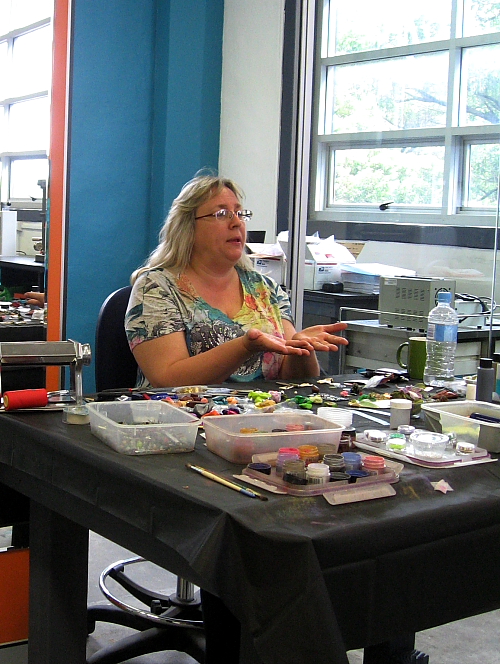
I consider myself very lucky to have such great opportunities to go to workshops fairly close to home (Sydney is only 167 km away) with well known artists . Yesterday, I attended a workshop with Christi Friesen, Polymer Clay Artist Extraordinaire - please click here  to see Christi's work.  The workshop was held in the fantastic new workshop of the Sydney Jewellery School - so lovely to work in such a light and spacious area.

And here are some of the pieces I made in the workshop - sort of " art nouveau". Some of the pieces need repairing as they weren't cured before the trip home to Newcastle and got a bit squashed in transit.  I was fairly happy, considering that I haven't made polymer clay jewellery for a couple of years.
And today we celebrated a grandson's fourth birthday...  what a happy weekend it's been.


Comments

  1. Loving that jewellery Wilma.

    ReplyDelete
  2. beautiful... ru sure you haven't made jewelry for a long time? wow you r good!

    ReplyDelete

Post a Comment

Thanks for reading my blog and please share your thoughts about my blog post by leaving a comment.Your comment won't appear immediately as comments are verified before publication in an effort to reduce the amount of spam appearing. Anonymous comments will not be published.

Popular posts from this blog

Lilly Pilly

Today is Australia Day. I chose a photo of some Lilly Pilly berries as a celebratory image for this national day. Lilly Pilly is  a common name for a plant, Syzygium smithii which grows mostly in Eastern Australia, from the northern  rain forests of Queensland, throughout NSW to the southern Wilson's Promontory in Victoria. In New Zealand it is called "monkey apple, but other names used in Australia, besides lilly pilly, are Eungella Gum and Coast Satinash. The largest Lilly Pilly recorded was found in Dingo Creek Flora Reserve, near Tenterfield where I once lived.  The tree now growing in my garden was once a small seedling which I was gifted when I left Woolgoolga, a small coastal town in northern NSW. Its name  is said to come from the Aboriginal word 'weelgoolga' describing the lilly pilly which grows in profusion there. It is probably no surprise that the lilly pilly berries are edible as bush tucker, and make a beautiful jam or jelly. I have even seen re...

Countdown to Christmas 15 - Diamonds Forever!

How much would you pay for a Christmas  fruitcake?  The world's most expensive fruit cake has been estimated at $1.65 million. Yesterday, I wrote about the less than positive term "Christmas cake as it is applied to unmarried women, so again it amazed me that  in Tokyo, this most exquisite and expensive Christmas cake was created. It took six months to design and another full month to construct. The beautiful cake is fully edible ... that is except for the 223  real diamonds  used as decoration. This cake was part of an exhibition called Diamonds: Nature's Miracle  and was one of 16 exhibits showcasing creative ways with diamonds . Apparently, the cake was auctioned, fetching $1.65 million US. While there have been other very expensive diamond encrusted cakes since this one in 2005 with estimated values of up to $75 million, this Japanese designed cake was the forerunner of the extravagant diamond studded wedding cakes in the higher price r...

"Temari Or Not Temari?" Tutorial

 Background Information:  Temari (literally translated “hand ball”) is a Japanese folk craft that is alleged to have originated in China and was introduced to Japan five or six hundred years ago. Traditionally, the balls were constructed from wrapped kimono fabric remnants and silk threads. They were made by mothers and grandmothers for children to play with. Nowadays, decorative embroidered temari represent a highly valued and cherished gift symbolizing friendship and loyalty. Recently I've wondered if your don't use traditional techniques whether you should call what you create "temari". That is an ongoing debate but today I share what I do to make a "non-traditional temari".... 1.I start  with a polystrene ball ( traditionally the balls were wound  silk scraps or other organic materials) and begin to wrap with approx 4 ply wool, turning the ball as I wrap.  2. I then wrap another layer of wool in a similar fashion , this time a 3 or 2 ...