
Yarn Bombing Day


Thu Jun 11th, 2020
Yarn Bombing Day
·          
·          
·          
Pearl one, drop one?


Yarn Bombing Day is a day when fibre lovers all over the world go a bit crazy and ensconce everyday objects in woolly patterns. It is sometimes called yarn storming or guerilla knitting. 
from ABC Newcastle 

No matter what you call it, it is simply the practice of knitted  or crocheted works of art being added to public places.   For example some sort of colourful knitted pattern and wrap it around a bus stop. The aim of this practice was to try and take knitting from something that was viewed as merely for creating clothes and hats to something that could add meaning and colour to urban locations. It’s not like standard graffiti where the point is to mark your territory. It’s also definitely not an act of vandalizing. It is about creating a sense of belonging and conveying meaning, as well as drawing attention to something that is ignored by most people. Yarn Bombing Day, therefore, is simply a celebration of this tradition, raising awareness of the art of crochet and knitting while having a lot of fun in the process.  (from Days of the Year )


from mewcastleherald.com.au 
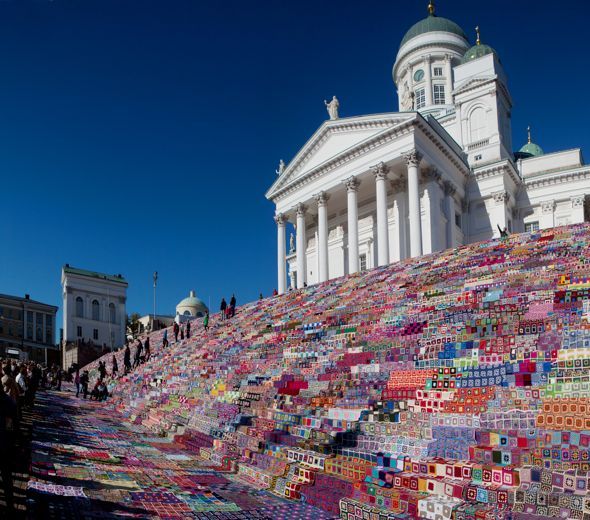
Last year, here in Newcastle, a very strange incident occurred where a busy corner was relocated and left the telegraph pole in the middle of the road. It became the obvious place for a bit of advertising for a good cause. My all time favourite example of yarn bombing was on the steps of the Helsinki Cathedral, Finland . In 2011, over 8,000 wool blankets were made for the bombing. These were all later donated to charities worldwide. 

from lorinotes.wordpress.com 
So today, my bit for yarnbombing day is a mini version.... it is Day 66 og #the100dayproject and the series #100pinpoems. 
"They're called gureillas, /but they're peace-loving knitters./ Yarn Bombers unite! "  - yarnbombed driftwood wearable art pin. 


Comments

Popular posts from this blog

Fish and Sticks : Art Dolls

This week I've been working on fish and sticks ....  The sticks are the message stick art dolls which were very popular, attracting some attention and a few orders at the Wise Women exhibition. Each of the message stick dolls are from the Wise Women series, each with her own personality and  message of wisdom, handwritten on a handmade timber tag. I gather the sticks during my walks around my neighbourhood and the tags are made from special bits of timber, some collected by me or  my husband or from off cuts gifted to us  from another doll making friend whose husband makes bagpipes. These dolls start off very simply with a wrap around a stick, in the general shape of a body. 'Naked" message stick dolls - strips of wadding wrapped around found sticks.   Then I usually wrap other layers of fabric, wool, and/or fibres, over which I do some simple embroidery. I sculpt  or mould small face masks for these dolls. I really like using "sari ribbon" as w...

Evolution of Message Stick Art Dolls

Message Stick Art Doll - stick, polymer clay, hand dyed & stencilled fabric with embroidery  My    message stick art dolls    have evolved over the last couple of years.  Why have I called these art dolls “Message Sticks” ?    I wanted to recreate a doll which was based on traditional techniques, so I have used ideas from a few different cultures. Many traditional dolls were made from wood - often wrapped with fibres.   In Egypt, several types of paddle dolls have been discovered in tombs in Egypt. The dolls are made of wood, flat, and constructed in a shape has led the form to be called a 'paddle doll'. The dolls seemingly follow a convention for the female figure, emphasizing the hips and hair. The wooden figures are usually painted with a geometric pattern of lines and dots. These patterns may reproduce tattos or ritual scaring in female Egyptian culture of the period or represent clothing or jewellery.  A fine exampl...

Fragments

 Some days are just your lucky days - today I was very fortunate and privileged to open the first ever Australian exhibition "Fragments" by  UK  Fibre Artist  Sue Hotchkis .  Here is a little about the techniques of this amazing textile artist from her own website  ...  Working intuitively with print and stitch, marks, textures and colours are exaggerated, intensified to reveal the detail and complexity within the images. Materials are deconstructed using modern methods, ripped, burnt and dyed. Time is invested in their reconstruction; pieces can take from a week to several months to create. Whilst being aesthetically pleasing the work can also act as a metaphor for deterioration and ruin, associated with urban decay and ultimately death and loss. They evolve organically, built up with layers of print, cloth, paper, and stitch into three-dimensional abstract forms that hover between object and image; to create a unique, visual and tactile lan...