Winter Beach : Tag Tuesday

"Beach" tags for Tag Tuesday 
Last weekend, I was very privileged to do a workshop with Belgium based artist, Jette Clover.  One of Jette's series of small works features postage stamps of famous people, so after the workshop I rediscovered my stash of stamps ( most of them still attached to envelopes). Fortunately for me, this fortnight's Tag Tuesday theme is " The Beach" which seems to be recurring theme for Australian stamps.  These collage tags have been assembled from torn bits of painted paper, magazine pages and stamps. I have called these tags "Winter Beach" as  the beach still looks as bright and the water as blue even  in winter here in Newcastle. Today's  winter maximum temperature was 16 degrees C with a clear blue sky and warm sunshine.
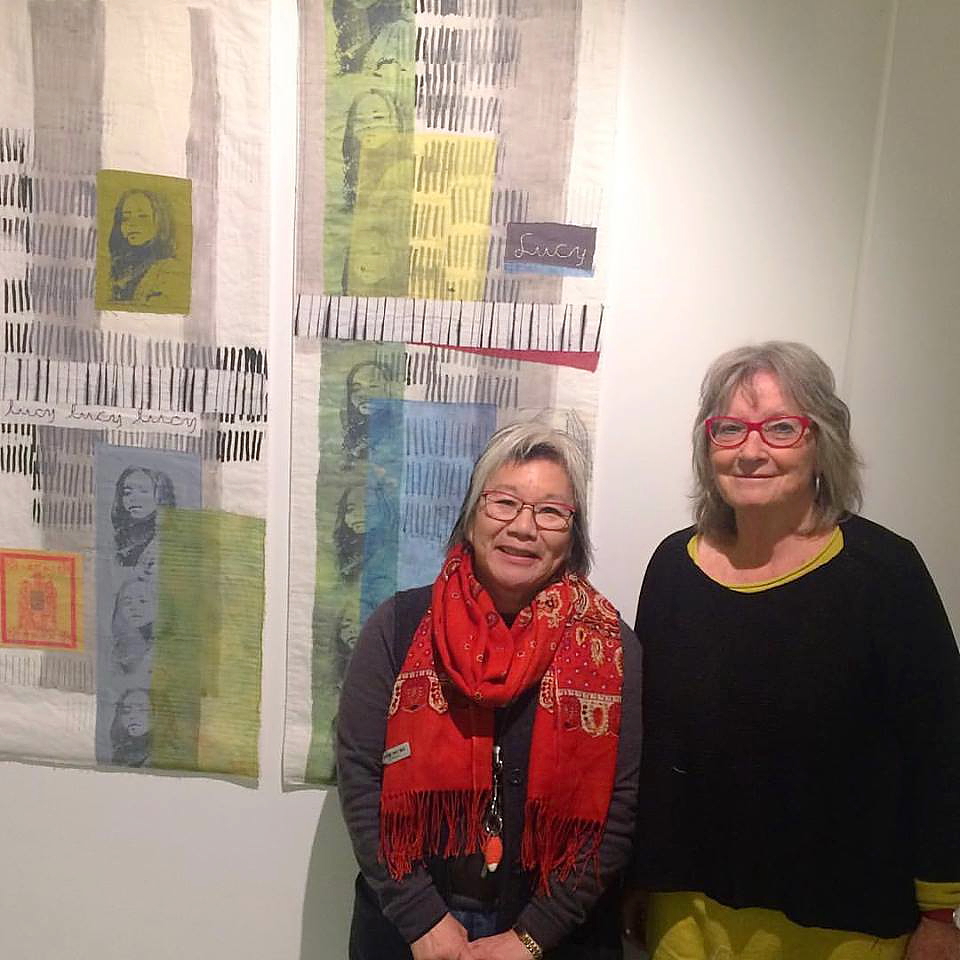
...with Jette Clover in fromt of her art work " Lives of Girls and Women" in  the STITCHED UP exhibition. 


Comments

  1. Both tags are terrific Wilma. Looks like you had a good time

    Love Chrissie xx

    ReplyDelete
  2. Glad you were able to enjoy the workshop. Love your torn paper tags, and thanks for supporting us again at TT. Hugs, Valerie

    ReplyDelete
  3. Great tags - I love the torn paper and the use of the postage stamps!!!

    ReplyDelete
  4. I love the winter beach tags. There's something fantastic about the beach in that season-sometimes its even better than in the summer. :) Erika

    ReplyDelete
  5. I was delighted to see that you came up with a winter theme for your tags. They are fabulous. I am a BIG fan of postage stamps, so those spoke to me, too. Beautiful work.

    I was very impressed with Jette Clover's fabulous art pieces. They were quite impressive and dynamic.

    ReplyDelete
  6. Two great tags, love the torn paper seascape.

    ReplyDelete
  7. lovely winter beach tags! how fun to meet the artist and get to do a workshop, lucky you! xo

    ReplyDelete

Post a Comment

Thanks for reading my blog and please share your thoughts about my blog post by leaving a comment.Your comment won't appear immediately as comments are verified before publication in an effort to reduce the amount of spam appearing. Anonymous comments will not be published.

Popular posts from this blog

#SeptTextileLove26 Day 7

  #SeptTextileLove #STL26Day7 ‘Historical’ ... Family history is often a source of inspiration and information for my work. This stitched work featuring a photo of my great grandmother also acts as a commentary on the Chinese historical practice of foot binding, hence the inclusion of an x ray photograph of a female bound foot. It looks painful and undoubtedly was , but it was considered 'beautiful". What contemporary body shaping practices do we still engage in for the sake of ‘beauty’? Historical body shaping practices included tight-lacing corsets, foot binding, and neck elongation , all used to mould the human form into culturally defined ideals of beauty. (AI overview) Foot Binding in China Starting from Song elites and eventually popularized and ended in the Qing dynasty, foot binding was seen as an idolized representation of women's petite beauty, and the practice was referred to as "三寸金莲" , 'three-inch golden lotus' Wikipedia . This practice...

#SeptTextileLove26 Day 4

 #septtextilelove  #stl26day4  … Story-telling … making ‘art dolls’ gives wonderful opportunities to tell stories … This matriarch’s story  is intertwined with the cicadas which form  part of the soft sculpture  and emphasises what appears to be a contradiction about nurturing life and inevitable death... Cicadas spend years underground as nymphs feeding on root sap, emerging en masse as winged adults for a few days, perhaps a week, to mate and lay eggs in tree branches, then die, leaving the eggs to hatch into new nymphs that burrow underground to restart the cycle.  The dormant underground phase of the cicada’s life can be from 2-17 years! In my interpretation, this forest matriarch offers a safe place for cicadas to lay eggs, only to cause their own demise … but the continuing life cycle is ensured. 

Christmas Firsts #18 : Where in the World?

Where in the world will FIRST  experience Christmas Day? Because of the time zones and daylight saving , the first places will be   Samoa,    Tonga  and Kiritimati (Christmas Island) . They   are the first places to welcome Christmas. New Zealand and Australia see in Christmas Day soon after,  while American Samoa and Baker Island in the United States of America are among the last. These statistics are more often quoted in relation to New Year's Eve, but I think it seems appropriate that Christmas Island is one of the first to celebrate Christmas in the world.  Kiritimati,    or Christmas Island, is a Pacific Ocean raised coral atoll in the northern Line Islands. It is part of the Republic of Kiribati. The name "Kiritimati" is a respelling of the English word "Christmas" in the  Kiribati language   The island has the greatest land area of any  coral atoll  in the w...