
Wednesday's Children Are Stitched Up


Neglecting my blog in the last month was one of the sacrifices I made for Wednesday's Children. Just a recap since it's been such a long time since I mentioned them.  Here is my submission for the exhibition "Stitched Up" - bringing to life the girls who were  placed in care at the Newcastle Industrial School 1867-71. I have now created 193 art dolls, made from sticks and strips of cloth.

Wednesday’s child is full of woe (from a nursery rhyme c.1838)
The stories of each of the girls in the Newcastle Industrial School and Reformatory   have been r researched by local historian, Jane Ison. Each story captured my heart.... 
Stick dolls seemed an appropriate way for me to honour the life of each of these girls and to compensate for lost childhoods.  I like to think if they had the opportunity they might have made little dolls from found materials - sticks and scraps of fabric, just as I enjoy making them 150 years later. These dolls are artistic representations and are not intended to be accurate or lifelike depictions of the girls.  In the installation, there are 193 stick “figures” wrapped in layers of cloth and individually stitched and sculpted Their different sizes and shapes draw attention to their individuality. Some have their hands ‘tied’ (knotted cloth), others have their arms raised in defiance (natural fork in a branch)  or hanging loosely in quiet resignation. (thin branches).The  polymer clay faces are individually sculpted to convey some of the sadness and misfortune  of the girls’ lives.
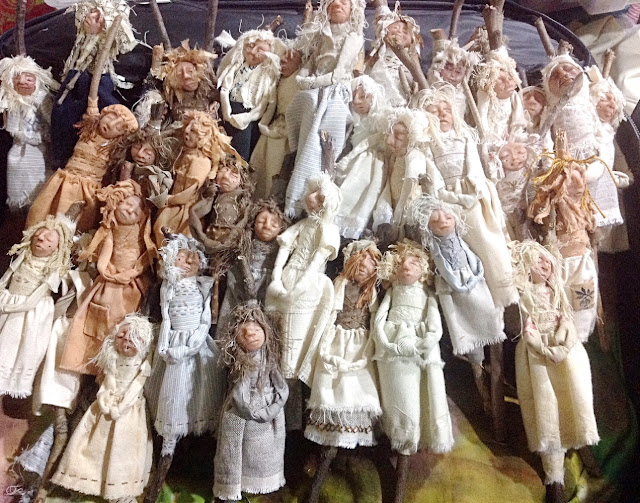
 In a previous post, I said  that this post would focus on how  the arms are made, so if you have been following the posts in this series, you have a set of mini-tutorials so you can create your own stick doll. 
1. The easiest way to improvise arms on a stick doll is to choose a suitable branch. In the group I made, I wanted to portray the defiant behaviour of some of the girls... The natural fork of a branch  to me was the shape of  arms held up in protest  by the escapees from the institution.

2. The next easy way is to choose two small twigs and wrap them in cloth, and stitch them into place . These straight stick arms I think suited the girls who were compliant or had  learnt to tolerate their fate.


3. For many of the dolls in this installation, I wanted to show that these girls were not only 'stitched up' but  were defenceless and unprotected  - their 'hands were tied'.... hence the arms and hands are strips of  knotted cloth. I also improvised a sleeve from the same piece of fabric. 
Step 1. Iron a strip of fabric - approx 10cm/4 inches longer than the total length of arms for the doll. As I made 193 of these dolls by hand , I did not stitch this strip, but of course, you could fold the fabric right sides together lengthwise and stitch by machine and turn the strip out to the right side. 

 Step 2 ; Tie a know in the middle of the strip - these are the improvised hands.
 Step 3. Stitch at the top of the arm and secure, and then turn the remaining fabric inside out
 Stitch on the top of the arm line to the body of the doll.
Step 4. Turn  the end of the strip  towards the bottom of the arm, so that it creates a sleeve and sew an inside seam. 

Step 5: Secure the arm and sleeve to the body  of the doll by ladder stitching or slip stitching around the top of the sleeve and taking a stitch right through the sleeve and the body to hold in place

Hope you have enjoyed this series of mini tutorials and you will try to create a stick doll of your own. 


'STITCHED UP' Exhibition  opens at "The Lock Up' in partnership with Timeless Textiles Gallery - 90 Hunter Street, Newcastle NSW Australia.  on 23 June,  6pm , until 6 August. 
Featuring 24  international and national artists 
Co-curatedby Anne Kempton and Wilma Simmons 


Comments

  1. I saw these at Timeless textiles all set up and they we’re memorising. I took my time as I walked around investigating every detail. Thank you for sharing more details about them.

    ReplyDelete
  2. I am across your sculptures on Pinterest. They immediately arrested my attention and moved me deeply. For the pain and suffering of one sister in particular. My heart is breaking.

    ReplyDelete

Post a Comment

Thanks for reading my blog and please share your thoughts about my blog post by leaving a comment.Your comment won't appear immediately as comments are verified before publication in an effort to reduce the amount of spam appearing. Anonymous comments will not be published.

Popular posts from this blog

Christmas Countdown #25envelopes/9 : Holly

  9 December Christmas Countdown #25envelopes : Holly . The Druids of ancient Britain believed holly leaves had great powers of fertility and longevity . Nowadays, Holly has become a symbol of a Christian Christmas. It is also said that the sharp holly represents the crown of thorns that Jesus wore, and the red berries the blood he shed, so it has quite a religious significance. Today’s envelope is a simple collage with paper and fabric. I couched (stitched) Holly ribbon and embroidered French knots for the berries. The Holly theme is inspired by one of my favourite Australian Christmas stamps, depicting an angel with holly leaf wings . Today, I was stitching the holly ribbon onto the envelope at the Wednesday group and had planned to glue on some paper berries but a friend convinced me that embroidered ones would look much better and I think she is right!

#SeptTextileLove26 … Introduction.

  A last minute decision to join #septtextilelove26 … so here I am #stl26day1 … Wilma from Newcastle, NSW , Australia , stitching in my garden - my favourite way to spend the day.  I love working with textiles and found objects and as I get older, I enjoy and appreciate the gentle calm of stitching even more . #septtextilelove #empresswu seam collective #SeptTextileLove — 2026 edition! What began back in September 2017 has grown into something truly special — a welcoming textile community that comes together every single year! What makes #SeptTextileLove truly stand out? It’s the connection! Every day, we at seam go through all your wonderful posts and choose three to highlight and celebrate. It’s the conversation between participants, t— and it all comes together in our final prompt on Day 30: “Your favourite post from another participant” — a beautiful way to lift each other up and wrap up the month together. All of September: one textile prompt a day. Respond to as many o...

Christmas Firsts #18 : Where in the World?

Where in the world will FIRST  experience Christmas Day? Because of the time zones and daylight saving , the first places will be   Samoa,    Tonga  and Kiritimati (Christmas Island) . They   are the first places to welcome Christmas. New Zealand and Australia see in Christmas Day soon after,  while American Samoa and Baker Island in the United States of America are among the last. These statistics are more often quoted in relation to New Year's Eve, but I think it seems appropriate that Christmas Island is one of the first to celebrate Christmas in the world.  Kiritimati,    or Christmas Island, is a Pacific Ocean raised coral atoll in the northern Line Islands. It is part of the Republic of Kiribati. The name "Kiritimati" is a respelling of the English word "Christmas" in the  Kiribati language   The island has the greatest land area of any  coral atoll  in the w...