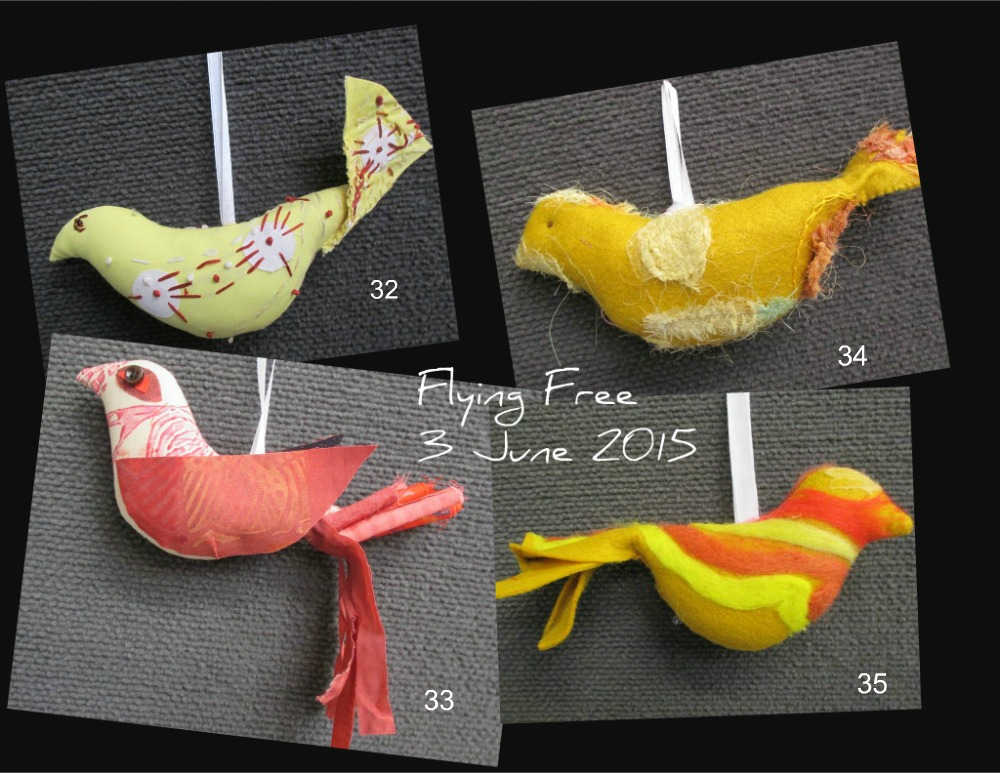
Flying Free - after a month....


It is now a month since the Flying Free Project was launched. Four free workshops have been held, averaging twelve participants each week. This project has been developed to honour and remember the women who tragically have died as a result of domestic violence. All  the proceeds from the sale of bird kits and completed birds on International Women's Day 2016 will be donated to women's refuges in our local area.  Unfortunately in the month we have been making birds, two women have been added to the sad statistics of 43 female domestic violence deaths in Australia this year... However, we have sat peacefully each Wednesday at Timeless Textiles Gallery stitching birds and I would like to share with you some of the  wonderful  moments and creative achievements of "Flying Free" in the last four weeks. Thanks to UK artist, Abigail Brown who gifted Timeless Textiles a basic pattern for a bird. . 


Another 15 + birds flew south to Curve Gallery, Hunter Street, Newcastle. 


Comments

Popular posts from this blog

Countdown to Christmas 20 - Fruitcake song!

There are many songs about fruit cakes  - not all of them referring to the Christmas cake we know and love.It is really surprising to learn via Google that there are 89 listed songs with references to Christmas cake or fruit cake - not all of them complimentary.   Probably one of the most famous folk songs about Christmas cake is Miss Fogarty's  Christmas Cake (a favourite sung by The Irish Rovers).  This first recorded comical Christmas song was written by C Frank Horn in 1883 in Pennsylania, as a variation of an Irish folk song, 'Miss Mulligan's Christmas Cake' . The chorus might give you the hint that Miss Fogarty's cake was not for the faint hearted or those who suffered from a weak stomach.    Chorus : There were plums and prunes and cherries, There were citrons and raisins and cinnamon, too There was nutmeg, cloves and berries And a crust that was nailed on with glue There were caraway seeds in abundance Such that...

Lilly Pilly

Today is Australia Day. I chose a photo of some Lilly Pilly berries as a celebratory image for this national day. Lilly Pilly is  a common name for a plant, Syzygium smithii which grows mostly in Eastern Australia, from the northern  rain forests of Queensland, throughout NSW to the southern Wilson's Promontory in Victoria. In New Zealand it is called "monkey apple, but other names used in Australia, besides lilly pilly, are Eungella Gum and Coast Satinash. The largest Lilly Pilly recorded was found in Dingo Creek Flora Reserve, near Tenterfield where I once lived.  The tree now growing in my garden was once a small seedling which I was gifted when I left Woolgoolga, a small coastal town in northern NSW. Its name  is said to come from the Aboriginal word 'weelgoolga' describing the lilly pilly which grows in profusion there. It is probably no surprise that the lilly pilly berries are edible as bush tucker, and make a beautiful jam or jelly. I have even seen re...

Too Precious to Waste

 Stitched tea bags/ old doily "tea lights" - Wilma Simmons  More than a year ago, a decision was made.  The annual exhibition of NCEATA ( Newcastle Creative Embroiderers and Textile Artists) 2015-2016 will have the theme "Mottainai". Mottainai in Japanese refers to more than just physical waste (resources). It is even used to refer to thought patterns that give rise to wasteful action. Grammatically, it can be used in Japanese as an exclamation ("mottainai!") or as an adjective phrase ("it feels mottainai"). There is no plural form. The collection of mottainai things could be called mottainai koto ( もったいない事 ? ). As an exclamation ("mottainai!") it means roughly "what a waste!" or "Don't waste." [2]  A simple English equivalent is the saying "waste not, want not." A more elaborate meaning conveys a sense of value and worthiness and may be translated as "do not destroy (or lay waste to) that ...