Blue Textiles


 I love working with blue .... much of my recent work is blue. In the latter part of last year I saw blue everywhere - I stitched a series of blue temari (embroidered thread balls) and felted dolls in shades of blue. 

- Blue Temari  - "Layered" exhibition ,January 2014. 
Blue felt doll - Bonnie 

Blue felt doll - Maribel 
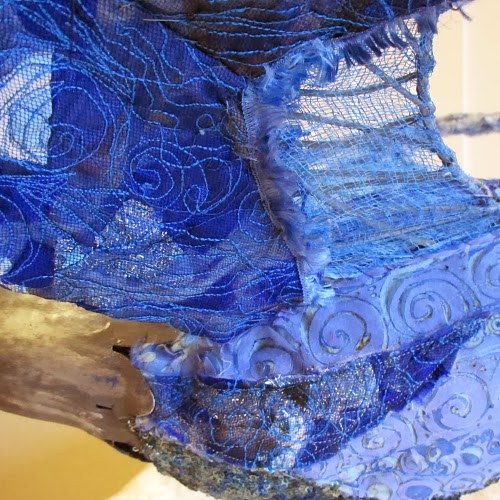
I love the colours of the traditional Willow Pattern… these blues induce a sense of calm and peace and the sight of a blue bird is often seen as a symbol of happiness and contentment…. One of the works in the current "Layered" exhibition by the Newcastle Creative Embroiderers and Textile Artists is  Blue Bird which was completed in December. I  covered a  wire frame  with different fabrics, which have been felted, stitched by hand and/or machine, painted and stamped, dyed. This textile art is a derivative of an earlier collaborative work created for International Women’s Day 2013.

Blue Bird - "Layered" exhibition , January 2014 


Close up of  textile art - Blue Bird 
My  new work for the Contemporary Craft Retreat in October 2014 are some mixed media collages on canvas. Blue again.... 

Willow Pattern Collage. 


Blue Represents
Communication: Blue relates to one-to-one verbal communication and self expression.
Peace and calm: Blue induces calm and peace within us, particularly the deeper shades.
Honesty: Blue is the colour of truth.
Authority: The darker the color blue, the more authority it has.
Religion: Blue is the colour of devotion and religious study.
Wisdom: Blue enhances the wisdom of the intellect.
from http://www.empower-yourself-with-color-psychology.com/ 

Comments

Popular posts from this blog

Christmas Firsts #11: Penguins

This year, I fell into the sentimental trap of making some penguin softies for Christmas .... and I am not the only one - penguins seem to be everywhere at the moment dressed in Christmassy costumes, with trees, bells, and all kinds of Christmas paraphernalia.   Should penguins really  be associated with Christmas?   Probably not  and not as Santa's helpers as they often depicted. Penguins inhabit the Antarctic region in the South Pole, while Santa Claus it has been established has his home in the North Pole. The theory is that somehow penguins are associated with snow, then Winter, then Christmas, but what about us in the southern hemisphere. Perhaps they are just cute?  Whatever the reason, when were penguins first seen as part of the Christmas scene ?  While there is no verifiable answer, it would seem that Monty the Penguin in the John Lewis Christmas advertisement in 2014  popularised  the trend. (If you are not famil...

Too Precious to Waste

 Stitched tea bags/ old doily "tea lights" - Wilma Simmons  More than a year ago, a decision was made.  The annual exhibition of NCEATA ( Newcastle Creative Embroiderers and Textile Artists) 2015-2016 will have the theme "Mottainai". Mottainai in Japanese refers to more than just physical waste (resources). It is even used to refer to thought patterns that give rise to wasteful action. Grammatically, it can be used in Japanese as an exclamation ("mottainai!") or as an adjective phrase ("it feels mottainai"). There is no plural form. The collection of mottainai things could be called mottainai koto ( もったいない事 ? ). As an exclamation ("mottainai!") it means roughly "what a waste!" or "Don't waste." [2]  A simple English equivalent is the saying "waste not, want not." A more elaborate meaning conveys a sense of value and worthiness and may be translated as "do not destroy (or lay waste to) that ...

Countdown to Christmas 20 - Fruitcake song!

There are many songs about fruit cakes  - not all of them referring to the Christmas cake we know and love.It is really surprising to learn via Google that there are 89 listed songs with references to Christmas cake or fruit cake - not all of them complimentary.   Probably one of the most famous folk songs about Christmas cake is Miss Fogarty's  Christmas Cake (a favourite sung by The Irish Rovers).  This first recorded comical Christmas song was written by C Frank Horn in 1883 in Pennsylania, as a variation of an Irish folk song, 'Miss Mulligan's Christmas Cake' . The chorus might give you the hint that Miss Fogarty's cake was not for the faint hearted or those who suffered from a weak stomach.    Chorus : There were plums and prunes and cherries, There were citrons and raisins and cinnamon, too There was nutmeg, cloves and berries And a crust that was nailed on with glue There were caraway seeds in abundance Such that...