
Bilby Girl : Traveling Art Doll

Fabric_-Animotion 1994 
Further adventures in Australia of the Traveling Art Doll.( please see the previous posts for more information -Australian Inspired Traveling Art Doll and  Art Dolls Only Traveling Art Doll
Today is Anzac Day, so it was a quiet afternoon and  I set to completing Lulu's doll. Here is what she looked like early this morning. As Lulu lives in USA, I wanted to give this doll an Australian touch ,too. 
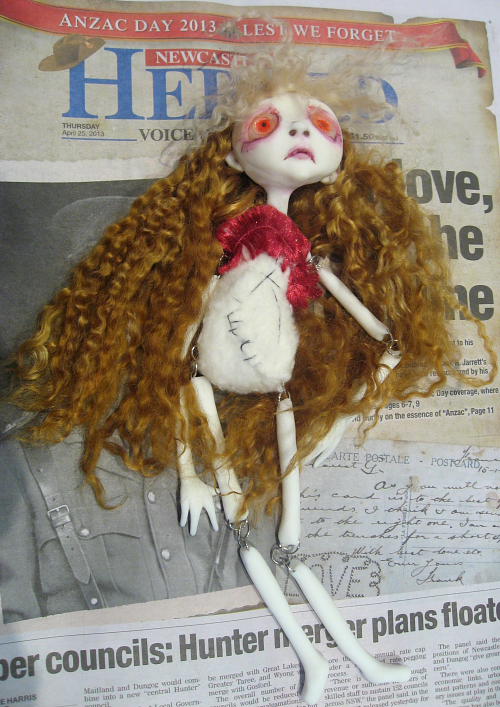
Lulu's doll as she arrived. 
I had intended to use the"Yalke" design fabric which I used on Martha's doll but once I held it against her body, with the fringed yarn already in place, it just didn't seem to work. This doll has a "spirit" look and I first thought of the Australian classic children's novel, "Playing Beatie Bow"  about the ghost girl who couldn't find her way back to 1873....  No....calico pinafore - a bit boring!  Then I remembered a vintage looking piece of Australiana fabric with a bright pink gum blossom. I have had this for a very long time. In theory this shouldn't work - the pattern was far too large for this little delicate body, but I just had to use the piece with the gum blossom, so like the fringed yarn. 
Machine stitching, Gum blossom fringe from sewing thread. 
Frayed fringe and organza underlay. 
With a little more of the fringed yarn I had in my own stash and the stitched piece of Animotion, I think she looks like a "bush spirit" ,but why is she so sad? 
Australian Bush spirit girl 
Then I had a thought - "Animotion "= animal + emotion. She is  Binda, the bush spirit girl saddened by the loss of many native animals. . So, I made her a bilby companion from the same fabric.  A bilby is a desert  dwelling Australian marsupial. One of the species became extinct in the 1950s and the other Macrotis lagotis remains endangered. The term bilby is a  word  from the Yuwaalaraay Aboriginal language of northern New South Wales, meaning long-nosed rat. In Australia, at Easter, many people replace the Easter Bunny with the Easter Bilby, raising awareness of the campaign to " Save the Bilby" . Binda is also a name of Aboriginal origin meaning " green place". 
Binda, the Bilby Girl

Binda will be posted to return home to USA tomorrow, and as there are only three of us in this Art Dolls Only team,  I will now wait for my doll to come home. You can see her now at Ayala Art  and before at Lulus Apples.   Thanks to other members of my team - Ayala Art and Lulus Apple for participating and letting me work on their dolls. 

Comments

  1. I love what you did with her, Wilma, and the little bilby, too! Thanks for teaching us about Australian culture and stories, too!

    ReplyDelete
  2. Wilma :) she is fantastic! I love the fabric and the meaning behind it all Thank you so much for working on my girl! I will treasure her forever :D my Bilby Girl!

    ReplyDelete

Post a Comment

Thanks for reading my blog and please share your thoughts about my blog post by leaving a comment.Your comment won't appear immediately as comments are verified before publication in an effort to reduce the amount of spam appearing. Anonymous comments will not be published.

Popular posts from this blog

Too Precious to Waste

 Stitched tea bags/ old doily "tea lights" - Wilma Simmons  More than a year ago, a decision was made.  The annual exhibition of NCEATA ( Newcastle Creative Embroiderers and Textile Artists) 2015-2016 will have the theme "Mottainai". Mottainai in Japanese refers to more than just physical waste (resources). It is even used to refer to thought patterns that give rise to wasteful action. Grammatically, it can be used in Japanese as an exclamation ("mottainai!") or as an adjective phrase ("it feels mottainai"). There is no plural form. The collection of mottainai things could be called mottainai koto ( もったいない事 ? ). As an exclamation ("mottainai!") it means roughly "what a waste!" or "Don't waste." [2]  A simple English equivalent is the saying "waste not, want not." A more elaborate meaning conveys a sense of value and worthiness and may be translated as "do not destroy (or lay waste to) that ...

"Temari Or Not Temari?" Tutorial

 Background Information:  Temari (literally translated “hand ball”) is a Japanese folk craft that is alleged to have originated in China and was introduced to Japan five or six hundred years ago. Traditionally, the balls were constructed from wrapped kimono fabric remnants and silk threads. They were made by mothers and grandmothers for children to play with. Nowadays, decorative embroidered temari represent a highly valued and cherished gift symbolizing friendship and loyalty. Recently I've wondered if your don't use traditional techniques whether you should call what you create "temari". That is an ongoing debate but today I share what I do to make a "non-traditional temari".... 1.I start  with a polystrene ball ( traditionally the balls were wound  silk scraps or other organic materials) and begin to wrap with approx 4 ply wool, turning the ball as I wrap.  2. I then wrap another layer of wool in a similar fashion , this time a 3 or 2 ...

Countdown to Christmas 20 - Fruitcake song!

There are many songs about fruit cakes  - not all of them referring to the Christmas cake we know and love.It is really surprising to learn via Google that there are 89 listed songs with references to Christmas cake or fruit cake - not all of them complimentary.   Probably one of the most famous folk songs about Christmas cake is Miss Fogarty's  Christmas Cake (a favourite sung by The Irish Rovers).  This first recorded comical Christmas song was written by C Frank Horn in 1883 in Pennsylania, as a variation of an Irish folk song, 'Miss Mulligan's Christmas Cake' . The chorus might give you the hint that Miss Fogarty's cake was not for the faint hearted or those who suffered from a weak stomach.    Chorus : There were plums and prunes and cherries, There were citrons and raisins and cinnamon, too There was nutmeg, cloves and berries And a crust that was nailed on with glue There were caraway seeds in abundance Such that...