
Year of the Dragon


Kung Hei Fat Choy - Cantonese for Happy New Year.
Welcome the Year of the Dragon . A very auspicious year  it would seem … from the International Business Times … The Year of the Dragon is one of the most revered years of the Chinese New Year calendar, and those born under the sign are regarded as innovative, passionate people who are colourful, confident and fearless…. the Dragon is sometimes called a "karmic sign." The Dragon is larger than life and its appearance means that big things are to come. The Year of the Dragon is a flowing river, not a stagnant lake, so things happen quickly earlier in the year. The Dragon marks progression, perseverance and auspiciousness. It may also bring about unpredictable events.

To celebrate the new year we spent a couple of days in Sydney with our  family for the launch of the Chinese New Year Festival. We are sorry we will not be able to enjoy the legendary parade next weekend, but it clashes with the beginning of the school year in NSW… not good to have grandchildren celebrating late into the night before their first day of term.
What does Chinese New Year mean to our family?
Being together as a family,  of course ….
 Food, food and more food….

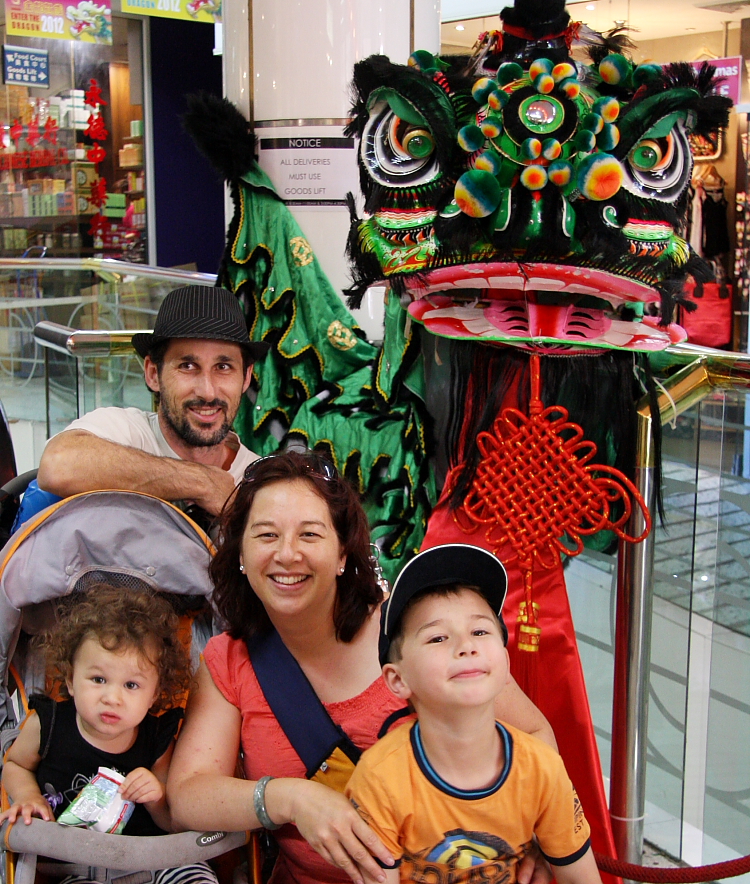
Tradition - Lion dances….

And parades ….

 Lots of good luck red….Red packets with money.... 

Making good wishes for the future .... 

New clothes in bright colours …
Chasing away  the bad spirits….
And welcoming the new and the good ….
                                       
Learning about heritage ….
Religious observance...

Reflection and meditation...
 Just having fun together regardless of the weather.... 
And when any more celebrating is just too much, there's nothing better than a vegemite sandwich and a sleep in the arms of someone who loves you....

Thanks to my beautiful family for making this Chinese New Year  celebration very special for me and to all  my friends and family my  best wishes for happiness, peace and love in the Year of the Dragon. 


Comments

  1. Wilma, what a wonderful post.I checked my bloglist and your blog was still listed, I hadn't removed , or altered it, but it wasn't coming upo on sidebar.Not sure why.Added again, now comes up.
    Tag Tuesday..thanks for telling me about it. What fun..the next month will possibly be a mini book!!
    Cheers
    Judy

    ReplyDelete
  2. Thanks Judy - sorry didn't mean that you had to change settings etc... I just remembered you had an interest in the Chinese New Year traditions for one of your students a couple of years back. So happy you are enjoying Tag Tuesday.

    ReplyDelete
  3. Beautiful photos and text - thanks Wilma for your good wishes and a Happy New Year to you.

    ReplyDelete

Post a Comment

Thanks for reading my blog and please share your thoughts about my blog post by leaving a comment.Your comment won't appear immediately as comments are verified before publication in an effort to reduce the amount of spam appearing. Anonymous comments will not be published.

Popular posts from this blog

"Temari Or Not Temari?" Tutorial

 Background Information:  Temari (literally translated “hand ball”) is a Japanese folk craft that is alleged to have originated in China and was introduced to Japan five or six hundred years ago. Traditionally, the balls were constructed from wrapped kimono fabric remnants and silk threads. They were made by mothers and grandmothers for children to play with. Nowadays, decorative embroidered temari represent a highly valued and cherished gift symbolizing friendship and loyalty. Recently I've wondered if your don't use traditional techniques whether you should call what you create "temari". That is an ongoing debate but today I share what I do to make a "non-traditional temari".... 1.I start  with a polystrene ball ( traditionally the balls were wound  silk scraps or other organic materials) and begin to wrap with approx 4 ply wool, turning the ball as I wrap.  2. I then wrap another layer of wool in a similar fashion , this time a 3 or 2 ...

Stitched Gardens and Magpies

  Magpies are always around  in our garden , strutting, poking about for insects and having a splash in the birdbath.  They often call if the water is at a low level in the birdbath until one of us replenishes the water supply. It is no coincidence then that they have figured prominently as part of  recent little works in the stitched garden series.  I also like to include human figures in my gardens, especially taken from old photos of family members. This "impressionist ' stitched garden features  my husband's great aunt,  Sarah Ann Bath.  I like to think of her in this abundant garden , when in reality,  she grew up  in the early 1900s in rather cramped living conditions in Birmingham UK  See more and read more about my stitched gardens - other posts:  How does your garden grow with stitch?  How does your garden grow with crayons? 

Dotee Divertissement

Dotee by Wendy Anderson  What is a "dotee' doll? ...  A dotee is a mini art doll, meant to be traded or swapped. The dolls 6 inches /15 cm tall or smaller, but the hanger or tail can exceed that measurement. They have a face, but do not require arms or legs. Dotees have a loop for hanging, and come with tails (tails are fibres, ribbon, charms or other string-y things that add to the theme of the doll). Dotees can be made from a variety of materials - fabric, felt, paperclay, yarn, beads, gourds or any other material/media that you can make a doll from. Most dotee makers add buttons, beads, sequins, embroidery, or charms to embellish the doll. Dotee dolls by Wilma Simmons At the February meeting of Gumnut Dollies Newcastle, the group activity was to revisit these little dolls, which were very popular for doll swaps around the world about 10 years ago. As our theme for 2020 is The Twenties, the little flapper girl face buttons were a good start....  Dot...