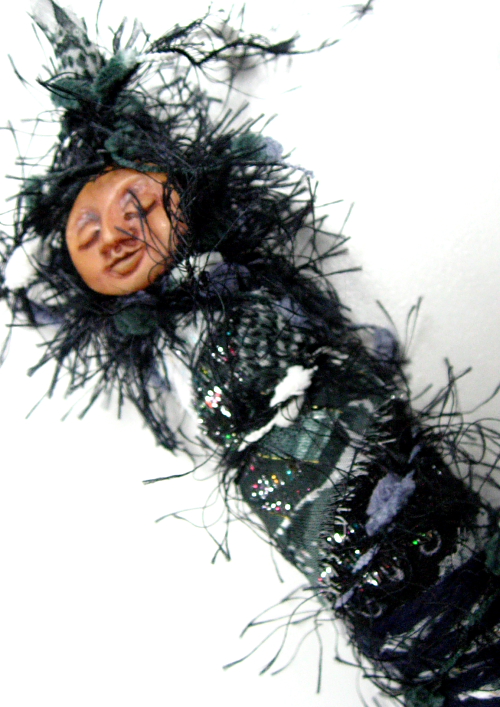
Student Dollmakers and Jam

Is there any connection between student dollmakers and jam? I guess both can be sweet? The real connection is these were two of my activites this week.  I went back temporarily to high school teaching this week in inner Sydney, teaching in a Links to Learning program - a program essentially for high school students having some difficulties either at school and/or at home. Although I was a high school principal, I have always thought that schools are not always the best places for learning for everyone, so it was good again to teach outside a school setting and doing something involving personal development. We made wrapped stick dolls and it was designed to be both a fun  and serious exercise, with the girls writing personal messages inside the doll, and then wrapping them with fabric and embellishing madly. I thought the results were great, and the exercise uplifting for all of us.


So, back at home, with an abundance of home grown mandarins from my sister-in-law's tree, I set out to look for recipes using mandarins. I found many including mandarin martinis, mandarin curd, mandarin syrup loaf, mandarin and chocolate muffins and a myriad of almond and mandarin cakes . However I settled for the "Exquisite Mandarin Jam" from Sally Wise on the ABC site. If you like the look of what I made ... here's the recipe.
Exquisite Mandarin Jam  ( Sally Wise)

Degree of difficulty: Low
You need: 8 mandarins, Water, Sugar, Juice of 1 lemon (optional but advisable)
Method:
Place (whole) mandarins and lemon juice in a pot and barely cover with water. Bring to the boil and then simmer till mandarins are tender. Remove from liquid, then chop or puree. Return the fruit to the pot. Measure the fruit and water mixture, then add equal part of sugar. Bring back to the boil, stirring to dissolve the sugar. Boil till setting point is reached (about 20 minutes) - the seeds will rise to the surface during this time, so they are easy to remove. Pour into sterilised jars and seal when cold

Comments

  1. Lovely of you to work with these "troubled" girls.I agree, school is only for the very "tough".I don't know how I lasted 30 years in schools.Kids who fall outside the "norm" are usually ignored until they start to "act out". Thank goodness for lovely people like yourself.Thankyou on behalf of those girls.

    ReplyDelete
  2. Thanks Judy
    I have enjoyed working with the girls. Although it is hard and unpredictable work, it is satisfying and challenges the grey matter.

    ReplyDelete

Post a Comment

Thanks for reading my blog and please share your thoughts about my blog post by leaving a comment.Your comment won't appear immediately as comments are verified before publication in an effort to reduce the amount of spam appearing. Anonymous comments will not be published.

Popular posts from this blog

Stitching Stories of Strength

  Last month, I was interviewed by Sian Goff , textileartist.org and here is the resulting article  Member Spotlight: Wilma Simmons  Stitching stories of strength When Wilma Simmons retired at 55 after a career as a high school principal, she made herself a promise: whatever came next would be creative. Two decades later, that promise has grown into a practice rooted in storytelling, sustainability, and a deep respect for the women who came before her. Based in Newcastle, Australia, Wilma has become a fixture of the textile art world, a longtime volunteer at the Timeless Textiles Gallery, a two-time solo exhibitor, and a member of Stitch Club almost since its very first year. Talking with her, it's easy to see why her work resonates: every piece carries a narrative, and every material has been chosen because it means something. Wilma Simmons , Thorax with Eucalyptus. Wilma Simmons , Wall, inspired by Ana Buzzalino. From clay and jewellery to cloth Wilma's crea...

"Temari Or Not Temari?" Tutorial

 Background Information:  Temari (literally translated “hand ball”) is a Japanese folk craft that is alleged to have originated in China and was introduced to Japan five or six hundred years ago. Traditionally, the balls were constructed from wrapped kimono fabric remnants and silk threads. They were made by mothers and grandmothers for children to play with. Nowadays, decorative embroidered temari represent a highly valued and cherished gift symbolizing friendship and loyalty. Recently I've wondered if your don't use traditional techniques whether you should call what you create "temari". That is an ongoing debate but today I share what I do to make a "non-traditional temari".... 1.I start  with a polystrene ball ( traditionally the balls were wound  silk scraps or other organic materials) and begin to wrap with approx 4 ply wool, turning the ball as I wrap.  2. I then wrap another layer of wool in a similar fashion , this time a 3 or 2 ...

Giveaway - Gifts for You on My Birthday

Giveaway Gifts T his week is blog giveaway time! Last week I celebrated my birthday.  I’ve had far too many to count the candles, but I had a wonderful party on the weekend with my family - with an indulgent birthday cake, favourite foods cooked by my husband and great company. ( In case you were wondering about the writing on the cake , Por Por = Chinese grandmother)     I also got great gifts from  my family and friends. There seemed to be a bit of a theme this year – with many of my gifts and cards depicting matryshoka ( babushka) dolls and tea drinking.   As it is also winter here in Australia ,   it was easy for me to  decide what I could offer as gifts  in this birthday giveaway. All the gifts are handmade by me. Gift 1 - two little fabric matryshoka dolls  Gift 2- a little bag made from colourful teapot and teacup fabric . The design is called a jester bag, but it is suitable for carrying s...