
Challenge Project


Finally on Friday, my project "Seasons" for the Hello Dollies challenge was ready for presentation on Saturday... as usual, last minute touches were needed. I decided on a "flat doll" project, for this challenge which was to "create your own fabric" to make a doll from a basic pattern provided. I thought the stump doll pattern lent itself easily to the flat doll idea. I had been working on the idea for a long time, making all sorts of different fabric, most of which was rejected and has since found other uses. I finally settled on four bits of  machine embellished  and embroidered fabric to complement a piece of space dyed commercial fabric on which I had stamped face images.
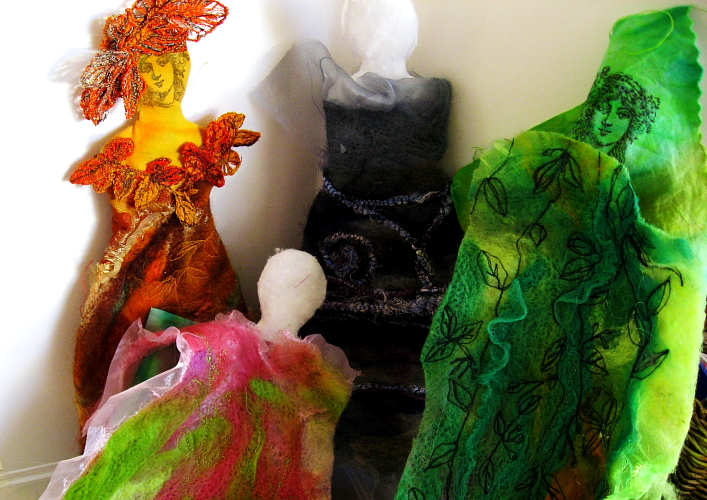

 Trying not to use anything other than what was in my stash, I chose a neutral coloured fabric for the background and gave it a bit of depth by going over the surface with a black fabric pastel with a textured mat  underneath. My original idea was to have these dolls appearing to be standing under an archway, so I used a photo from a sandstone advertisement and with the fantastic technology of my computer, printer, and Lesley Riley's Artist Transfer Paper with a bit free form machine embroidery, the arches ended up looking a lot like stone.
The final piece was quite different from my original concept, which started out with a tree as the central  image and a connection between the arches. I did make a tree, but didn't use it as it gave the whole project too many focal points. I have another idea for the tree!
Although I had this ready for the presentation, I am planning perhaps to have some branches entwining the arches and replacing the  green felt back with some "seasons" themed poetry or sayings printed onto fabric. Still making those decisions... any good ideas?

Comments

Popular posts from this blog

Fish and Sticks : Art Dolls

This week I've been working on fish and sticks ....  The sticks are the message stick art dolls which were very popular, attracting some attention and a few orders at the Wise Women exhibition. Each of the message stick dolls are from the Wise Women series, each with her own personality and  message of wisdom, handwritten on a handmade timber tag. I gather the sticks during my walks around my neighbourhood and the tags are made from special bits of timber, some collected by me or  my husband or from off cuts gifted to us  from another doll making friend whose husband makes bagpipes. These dolls start off very simply with a wrap around a stick, in the general shape of a body. 'Naked" message stick dolls - strips of wadding wrapped around found sticks.   Then I usually wrap other layers of fabric, wool, and/or fibres, over which I do some simple embroidery. I sculpt  or mould small face masks for these dolls. I really like using "sari ribbon" as w...

Lilly Pilly

Today is Australia Day. I chose a photo of some Lilly Pilly berries as a celebratory image for this national day. Lilly Pilly is  a common name for a plant, Syzygium smithii which grows mostly in Eastern Australia, from the northern  rain forests of Queensland, throughout NSW to the southern Wilson's Promontory in Victoria. In New Zealand it is called "monkey apple, but other names used in Australia, besides lilly pilly, are Eungella Gum and Coast Satinash. The largest Lilly Pilly recorded was found in Dingo Creek Flora Reserve, near Tenterfield where I once lived.  The tree now growing in my garden was once a small seedling which I was gifted when I left Woolgoolga, a small coastal town in northern NSW. Its name  is said to come from the Aboriginal word 'weelgoolga' describing the lilly pilly which grows in profusion there. It is probably no surprise that the lilly pilly berries are edible as bush tucker, and make a beautiful jam or jelly. I have even seen re...

"Temari Or Not Temari?" Tutorial

 Background Information:  Temari (literally translated “hand ball”) is a Japanese folk craft that is alleged to have originated in China and was introduced to Japan five or six hundred years ago. Traditionally, the balls were constructed from wrapped kimono fabric remnants and silk threads. They were made by mothers and grandmothers for children to play with. Nowadays, decorative embroidered temari represent a highly valued and cherished gift symbolizing friendship and loyalty. Recently I've wondered if your don't use traditional techniques whether you should call what you create "temari". That is an ongoing debate but today I share what I do to make a "non-traditional temari".... 1.I start  with a polystrene ball ( traditionally the balls were wound  silk scraps or other organic materials) and begin to wrap with approx 4 ply wool, turning the ball as I wrap.  2. I then wrap another layer of wool in a similar fashion , this time a 3 or 2 ...