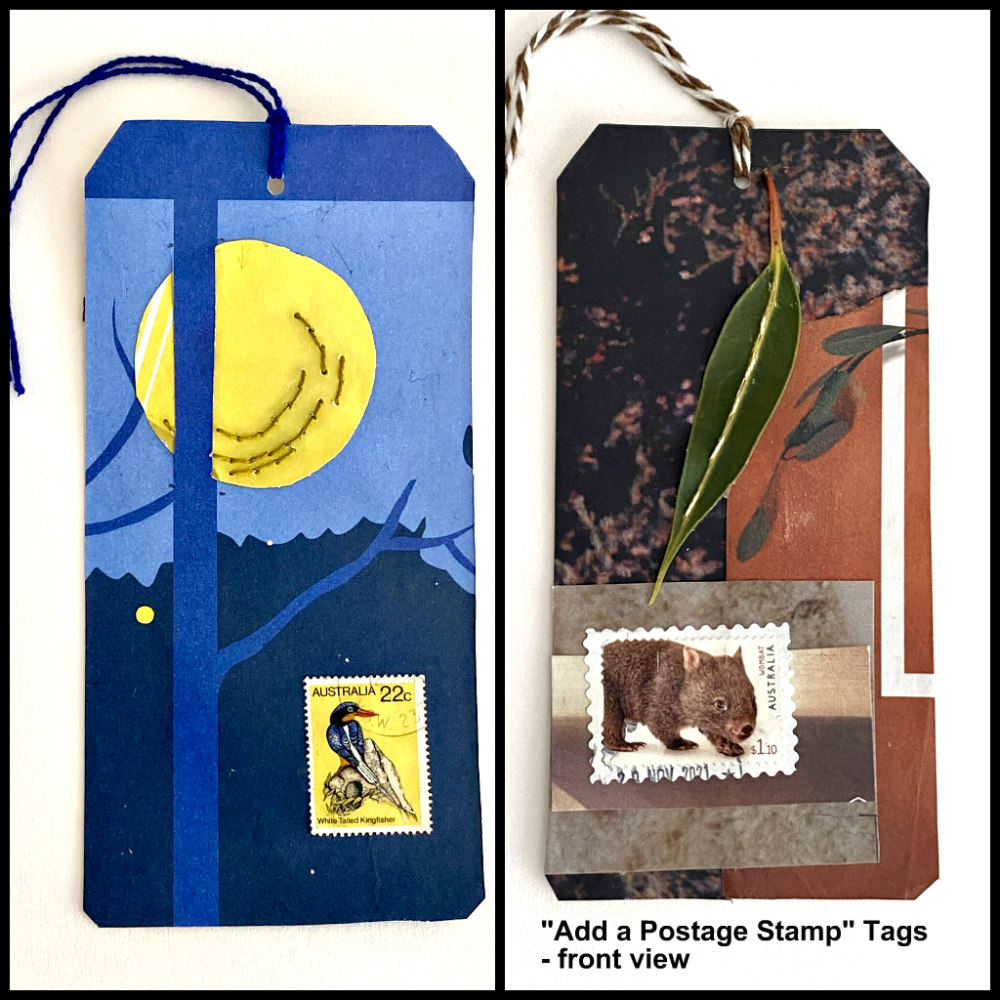
"Add a Postage Stamp" Art Tags


I couldn't have hoped for a more suitable theme set for this fortnight's Tag Tuesday..... "Add a Postage Stamp". I often use postage stamps in my collage work, and I admit I really enjoy working with these miniature artworks. 

The two stamps I've chosen for this exercise are both Australian.  

The first one depicting a white tailed kingfisher is from a 1980 issue and this series is amongst my favourite "bird" series.


The second is from an Australian animal series issued in 2019  .... who doesn't love a wombat? 


The tags are both paper collages - with some stitching and  in the second, I stitched a real dried eucalypt leaf. And just to add a but of interest, I also decorated the backs of the tags, complementing the theme on the front. 


I hope you enjoy this glimpse of  the natural world in Australia... 


Comments

  1. Absolutely beautiful tags with the Australian wildlife and birds, love the detail on the moon, fabulous..

    Luv CHRISSYxx

    ReplyDelete
  2. Oh I absolutely love the stamps you have used and your tags showcased them beautifully! Thanks so much for playing along with us at Tag Tuesday.
    Pinky

    ReplyDelete
  3. These are great tags. I especially like the night scene or modern day scene, well the blue one.

    ReplyDelete
  4. i adore the beauty and simplicity of those gorgeous tags! always so nice to see you again at tag tuesday; thanks for linking up! xo

    ReplyDelete
  5. Your Tags are awesome, amazing sets of postage stamps, I love them. Thank you so much for supporting my theme at Tag Tuesday x

    ReplyDelete

Post a Comment

Thanks for reading my blog and please share your thoughts about my blog post by leaving a comment.Your comment won't appear immediately as comments are verified before publication in an effort to reduce the amount of spam appearing. Anonymous comments will not be published.

Popular posts from this blog

Fish and Sticks : Art Dolls

This week I've been working on fish and sticks ....  The sticks are the message stick art dolls which were very popular, attracting some attention and a few orders at the Wise Women exhibition. Each of the message stick dolls are from the Wise Women series, each with her own personality and  message of wisdom, handwritten on a handmade timber tag. I gather the sticks during my walks around my neighbourhood and the tags are made from special bits of timber, some collected by me or  my husband or from off cuts gifted to us  from another doll making friend whose husband makes bagpipes. These dolls start off very simply with a wrap around a stick, in the general shape of a body. 'Naked" message stick dolls - strips of wadding wrapped around found sticks.   Then I usually wrap other layers of fabric, wool, and/or fibres, over which I do some simple embroidery. I sculpt  or mould small face masks for these dolls. I really like using "sari ribbon" as w...

Countdown to Christmas 15 - Diamonds Forever!

How much would you pay for a Christmas  fruitcake?  The world's most expensive fruit cake has been estimated at $1.65 million. Yesterday, I wrote about the less than positive term "Christmas cake as it is applied to unmarried women, so again it amazed me that  in Tokyo, this most exquisite and expensive Christmas cake was created. It took six months to design and another full month to construct. The beautiful cake is fully edible ... that is except for the 223  real diamonds  used as decoration. This cake was part of an exhibition called Diamonds: Nature's Miracle  and was one of 16 exhibits showcasing creative ways with diamonds . Apparently, the cake was auctioned, fetching $1.65 million US. While there have been other very expensive diamond encrusted cakes since this one in 2005 with estimated values of up to $75 million, this Japanese designed cake was the forerunner of the extravagant diamond studded wedding cakes in the higher price r...

"Temari Or Not Temari?" Tutorial

 Background Information:  Temari (literally translated “hand ball”) is a Japanese folk craft that is alleged to have originated in China and was introduced to Japan five or six hundred years ago. Traditionally, the balls were constructed from wrapped kimono fabric remnants and silk threads. They were made by mothers and grandmothers for children to play with. Nowadays, decorative embroidered temari represent a highly valued and cherished gift symbolizing friendship and loyalty. Recently I've wondered if your don't use traditional techniques whether you should call what you create "temari". That is an ongoing debate but today I share what I do to make a "non-traditional temari".... 1.I start  with a polystrene ball ( traditionally the balls were wound  silk scraps or other organic materials) and begin to wrap with approx 4 ply wool, turning the ball as I wrap.  2. I then wrap another layer of wool in a similar fashion , this time a 3 or 2 ...