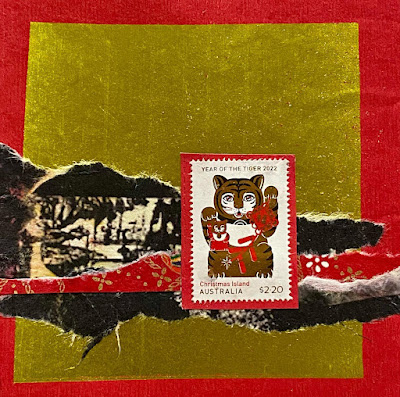
Chinese/ Lunar New Year


Today begins the beginning of the Lunar New Year. For my family, it is the Chinese New Year - the Year of the Tiger , or more specifically  the Year of the Black Water Tiger. 


There are many predictions published about  what this new year will bring.  ( just try Google - Year of the Tiger )  While individual predictions vary according to  your birth year and  your Chinese Zodiac animal, there is a general agreement amongst astrologers who say the tiger denotes strength, vitality and growth. These are qualities that will hopefully stand us all in good stead as we look to move past the uncertainty of COVID-19 in the past couple of years .


 Here is a guide to find out  your own Chinese Zodiac animal  - Always check the new year's date if you are born in the early months of the year,  because the first day of Chinese New Year begins on the new moon that appears between January 21 and February 20.

According to your year of birth, your Chinese sign is:

  • Rat: 1936, 1948, 1960, 1972, 1984, 1996, 2008, 2020
  • Ox: 1937, 1949, 1961, 1973, 1985, 1997, 2009, 2021
  • Tiger: 1938, 1950, 1962, 1974, 1986, 1998, 2010, 2022
  • Rabbit: 1939, 1951,1963,1975, 1987, 1999, 2011, 2023
  • Dragon: 1940, 1952, 1964, 1976, 1988, 2000, 2012, 2024
  • Snake: 1941, 1953, 1965, 1977, 1989, 2001, 2013, 2025
  • Horse: 1942, 1954, 1966, 1978, 1990, 2002, 2014, 2026
  • Goat: 1943, 1955, 1967, 1979, 1991, 2003, 2015, 2027
  • Monkey: 1944, 1956, 1968, 1980, 1992, 2004, 2016, 2028
  • Rooster: 1945, 1957, 1969, 1981, 1993, 2005, 2017, 2029
  • Dog: 1946, 1958, 1970. 1982, 1994, 2006, 2018, 2030
  • Pig: 1947, 1959, 1971, 1983, 1995, 2007, 2019, 2031


Once you have identified which animal you are, here  are some links  for more information about what the year has in store for you. 

1. It's Lunar New Year - Here's what the year will bring you in 2022

2. Year of the Tiger 2022: How to Bring You Year-long Good Luck for Horoscope in Chinese New Year

3. Chinese-horoscope 2022 - Year of the Tiger Meaning

And I  am sure that once you start searching you will  find literally hundreds of sites  which attempt explanations of the Chinese New  Year - and look out for all those delicious recipes which make  any new year celebrating. Happy New Year - Gong Hei Fat Choi - 新年快乐


Comments

Popular posts from this blog

Too Precious to Waste

 Stitched tea bags/ old doily "tea lights" - Wilma Simmons  More than a year ago, a decision was made.  The annual exhibition of NCEATA ( Newcastle Creative Embroiderers and Textile Artists) 2015-2016 will have the theme "Mottainai". Mottainai in Japanese refers to more than just physical waste (resources). It is even used to refer to thought patterns that give rise to wasteful action. Grammatically, it can be used in Japanese as an exclamation ("mottainai!") or as an adjective phrase ("it feels mottainai"). There is no plural form. The collection of mottainai things could be called mottainai koto ( もったいない事 ? ). As an exclamation ("mottainai!") it means roughly "what a waste!" or "Don't waste." [2]  A simple English equivalent is the saying "waste not, want not." A more elaborate meaning conveys a sense of value and worthiness and may be translated as "do not destroy (or lay waste to) that ...

Countdown to Christmas 20 - Fruitcake song!

There are many songs about fruit cakes  - not all of them referring to the Christmas cake we know and love.It is really surprising to learn via Google that there are 89 listed songs with references to Christmas cake or fruit cake - not all of them complimentary.   Probably one of the most famous folk songs about Christmas cake is Miss Fogarty's  Christmas Cake (a favourite sung by The Irish Rovers).  This first recorded comical Christmas song was written by C Frank Horn in 1883 in Pennsylania, as a variation of an Irish folk song, 'Miss Mulligan's Christmas Cake' . The chorus might give you the hint that Miss Fogarty's cake was not for the faint hearted or those who suffered from a weak stomach.    Chorus : There were plums and prunes and cherries, There were citrons and raisins and cinnamon, too There was nutmeg, cloves and berries And a crust that was nailed on with glue There were caraway seeds in abundance Such that...

Lilly Pilly

Today is Australia Day. I chose a photo of some Lilly Pilly berries as a celebratory image for this national day. Lilly Pilly is  a common name for a plant, Syzygium smithii which grows mostly in Eastern Australia, from the northern  rain forests of Queensland, throughout NSW to the southern Wilson's Promontory in Victoria. In New Zealand it is called "monkey apple, but other names used in Australia, besides lilly pilly, are Eungella Gum and Coast Satinash. The largest Lilly Pilly recorded was found in Dingo Creek Flora Reserve, near Tenterfield where I once lived.  The tree now growing in my garden was once a small seedling which I was gifted when I left Woolgoolga, a small coastal town in northern NSW. Its name  is said to come from the Aboriginal word 'weelgoolga' describing the lilly pilly which grows in profusion there. It is probably no surprise that the lilly pilly berries are edible as bush tucker, and make a beautiful jam or jelly. I have even seen re...