A Christmas Tree Story


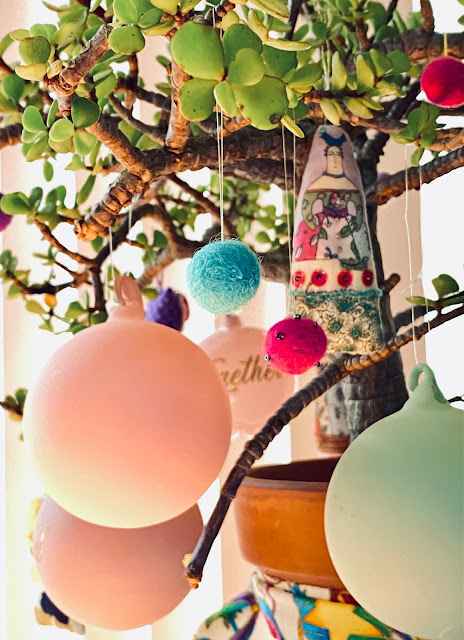
 Most years, I decorate a huge Christmas tree with hundreds of ornaments and sparkles, but this year our tree is so different .... it is a small jade tree in a pot, decorated in soft colours . 

The  little tree is  from a second generation cutting from my grandmother's jade tree, brought from Hong Kong, or so the family story claims. The baubles are frosted glass with our grandchildren's names on them, made by my daughter-in-law.  I added a few little dolls also in pastels and  I hung some felted balls .  These little balls were made in Nepal, a couple of  years ago at Seven Women, a centre  which empowers marginalised Nepalese women through education and employment.  There is a single wooden star resting on the top branch  of the tree. 


Somehow all this seemed appropriate with the unsettled and disturbing situation  of the fast spreading  Omicron variant of Covid -19  here in Newcastle ( NSW)  - these colours are calm, reassuring  and subdued . The tree decorations reflect the feeling of wanting to protect our own family and also remind us how lucky we are compared to those in other countries where the health services are not as accessible for so many. 


On Christmas morning, I placed a single star on the front door - a beautiful gift from my sister. It is made from handmade paper with an Aboriginal design - it fits this year's theme and intentions perfectly. 

I rather like the "pared back" look of Christmas in our home this year - perhaps it's a sign of  future Christmases ? 


Comments

Popular posts from this blog

Giveaway - Gifts for You on My Birthday

Giveaway Gifts T his week is blog giveaway time! Last week I celebrated my birthday.  I’ve had far too many to count the candles, but I had a wonderful party on the weekend with my family - with an indulgent birthday cake, favourite foods cooked by my husband and great company. ( In case you were wondering about the writing on the cake , Por Por = Chinese grandmother)     I also got great gifts from  my family and friends. There seemed to be a bit of a theme this year – with many of my gifts and cards depicting matryshoka ( babushka) dolls and tea drinking.   As it is also winter here in Australia ,   it was easy for me to  decide what I could offer as gifts  in this birthday giveaway. All the gifts are handmade by me. Gift 1 - two little fabric matryshoka dolls  Gift 2- a little bag made from colourful teapot and teacup fabric . The design is called a jester bag, but it is suitable for carrying s...

Fish and Sticks : Art Dolls

This week I've been working on fish and sticks ....  The sticks are the message stick art dolls which were very popular, attracting some attention and a few orders at the Wise Women exhibition. Each of the message stick dolls are from the Wise Women series, each with her own personality and  message of wisdom, handwritten on a handmade timber tag. I gather the sticks during my walks around my neighbourhood and the tags are made from special bits of timber, some collected by me or  my husband or from off cuts gifted to us  from another doll making friend whose husband makes bagpipes. These dolls start off very simply with a wrap around a stick, in the general shape of a body. 'Naked" message stick dolls - strips of wadding wrapped around found sticks.   Then I usually wrap other layers of fabric, wool, and/or fibres, over which I do some simple embroidery. I sculpt  or mould small face masks for these dolls. I really like using "sari ribbon" as w...

"Temari Or Not Temari?" Tutorial

 Background Information:  Temari (literally translated “hand ball”) is a Japanese folk craft that is alleged to have originated in China and was introduced to Japan five or six hundred years ago. Traditionally, the balls were constructed from wrapped kimono fabric remnants and silk threads. They were made by mothers and grandmothers for children to play with. Nowadays, decorative embroidered temari represent a highly valued and cherished gift symbolizing friendship and loyalty. Recently I've wondered if your don't use traditional techniques whether you should call what you create "temari". That is an ongoing debate but today I share what I do to make a "non-traditional temari".... 1.I start  with a polystrene ball ( traditionally the balls were wound  silk scraps or other organic materials) and begin to wrap with approx 4 ply wool, turning the ball as I wrap.  2. I then wrap another layer of wool in a similar fashion , this time a 3 or 2 ...